
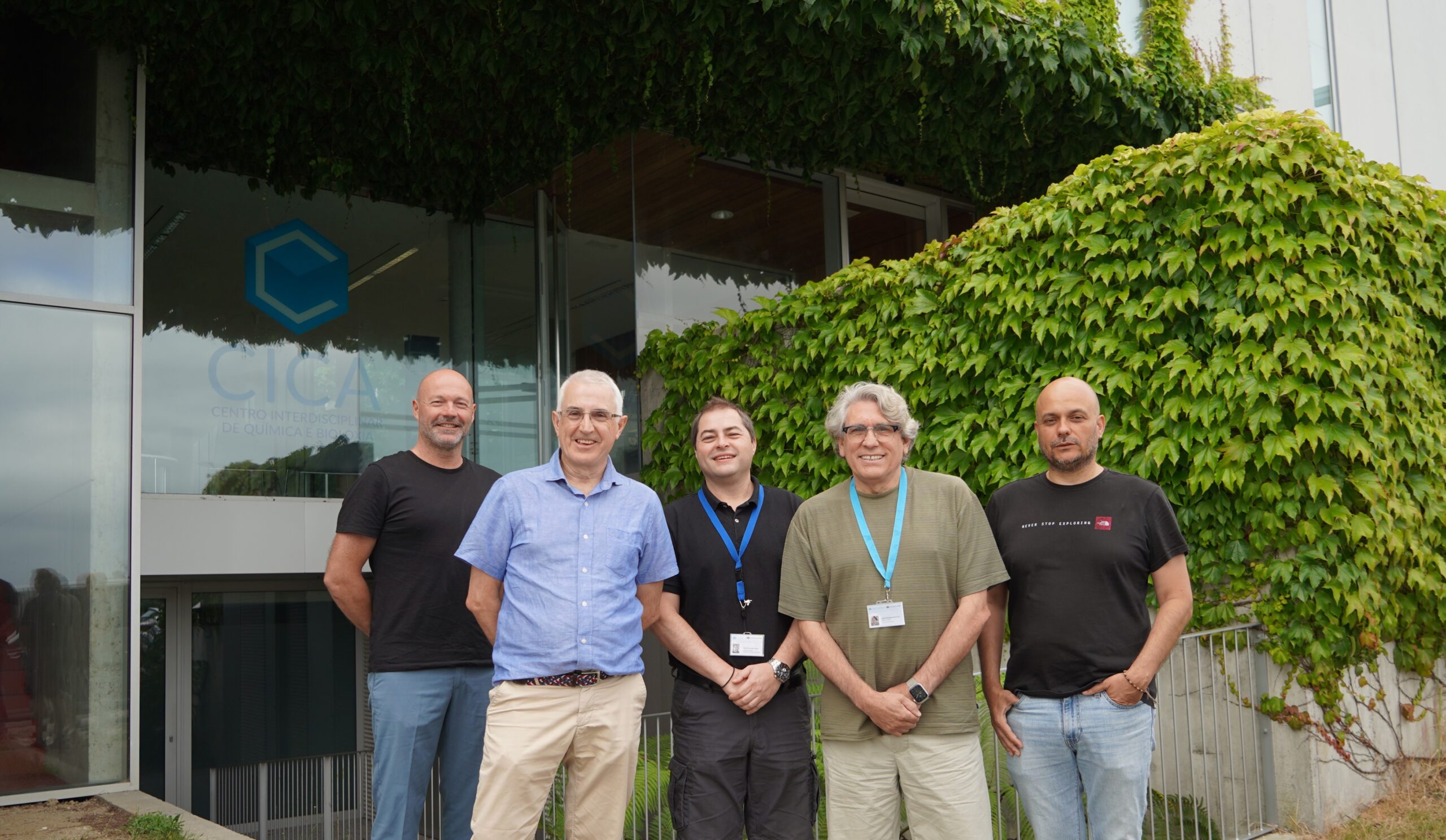
The Interdisciplinary Centre for Chemistry and Biology (CICA) at the Universidade da Coruña will coordinate CLIRAQUA (Climate Resilience and Adaptation in Aquaculture), an Interreg Atlantic Area project granted 1.96 million euros, with 75% funded by the European Regional Development Fund (ERDF). The initiative, which will run from July 2025 to December 2027, brings together twelve entities from Spain, Portugal, France, and Ireland, supported by associate entities from the production sector.
The research team combines expertise in coastal biology, marine bioactive products, evolutionary ecology, climate change, and biomedicine:
-
Jaime Rodríguez and Carlos Jiménez (PRONAMAR group): Experts in marine bioactive compounds, addressing the potential of these resources in sustainable aquaculture.
-
Javier Cremades and Rodolfo Barreiro (BIOCOST group): Researchers with extensive careers in coastal biodiversity, habitat restoration, and marine species.
-
Roberto Bao and Armand Hernández (GRICA): Responsible for climate analysis and the integration of predictive models.
-
Pablo Pita (GIBE): Specialist in evolutionary biology in marine systems, working on the adaptation of exploited species to new environmental conditions.
-
Daniel Torrecilla: Head of Projects, Innovation, and R&D Strategy; a technologist with experience in biomedicine, strengthening the innovation and European project management aspect.
Strategic Objective
CLIRAQUA is part of the strategic objective to promote climate change adaptation through ecosystem-based solutions and innovative technologies. Its purpose is twofold: to reduce the vulnerability of aquaculture species and environments to phenomena such as rising temperatures, salinity, or declining water quality; and to develop practical tools that enable producers, administrations, and local communities to anticipate and adapt to these challenges.
Key Expected Results
-
Atlantic Data Lake: An open repository with climate projections and ecological data, serving as the basis for interactive vulnerability maps.
-
Adaptive Management Protocols for producers and administrations, based on scientific-technical evidence.
-
Early Warning System for diseases associated with increased temperature and salinity.
-
Transnational Aquaculture Resilience Network to facilitate the transfer of best practices beyond the project’s lifespan.
A Multidisciplinary Consortium
The consortium is composed of universities, research centers, public agencies, and technological clusters from various countries:
-
Spain: Universidade da Coruña – CICA (coordination), University of Las Palmas de Gran Canaria (University Institute of Sustainable Aquaculture and Marine Ecosystems), Asociación Bioga – Life Sciences Technological Business Cluster, Institute of Marine Research – Spanish National Research Council (CSIC), and Seafood Legacy SL.
-
Portugal: Interdisciplinary Centre of Marine and Environmental Research (CIIMAR), Instituto Português do Mar e da Atmosfera (IPMA), Universidade dos Açores.
-
France: Institut National de Recherche en Agriculture, Alimentation et Environnement (INRAE), Centre pour l’aquaculture, la pêche et l’environnement de Nouvelle-Aquitaine (CAPENA).
-
Ireland: Marine Institute, University of Galway.
The project will have a duration of 30 months, running from July 2025 to December 2027.