
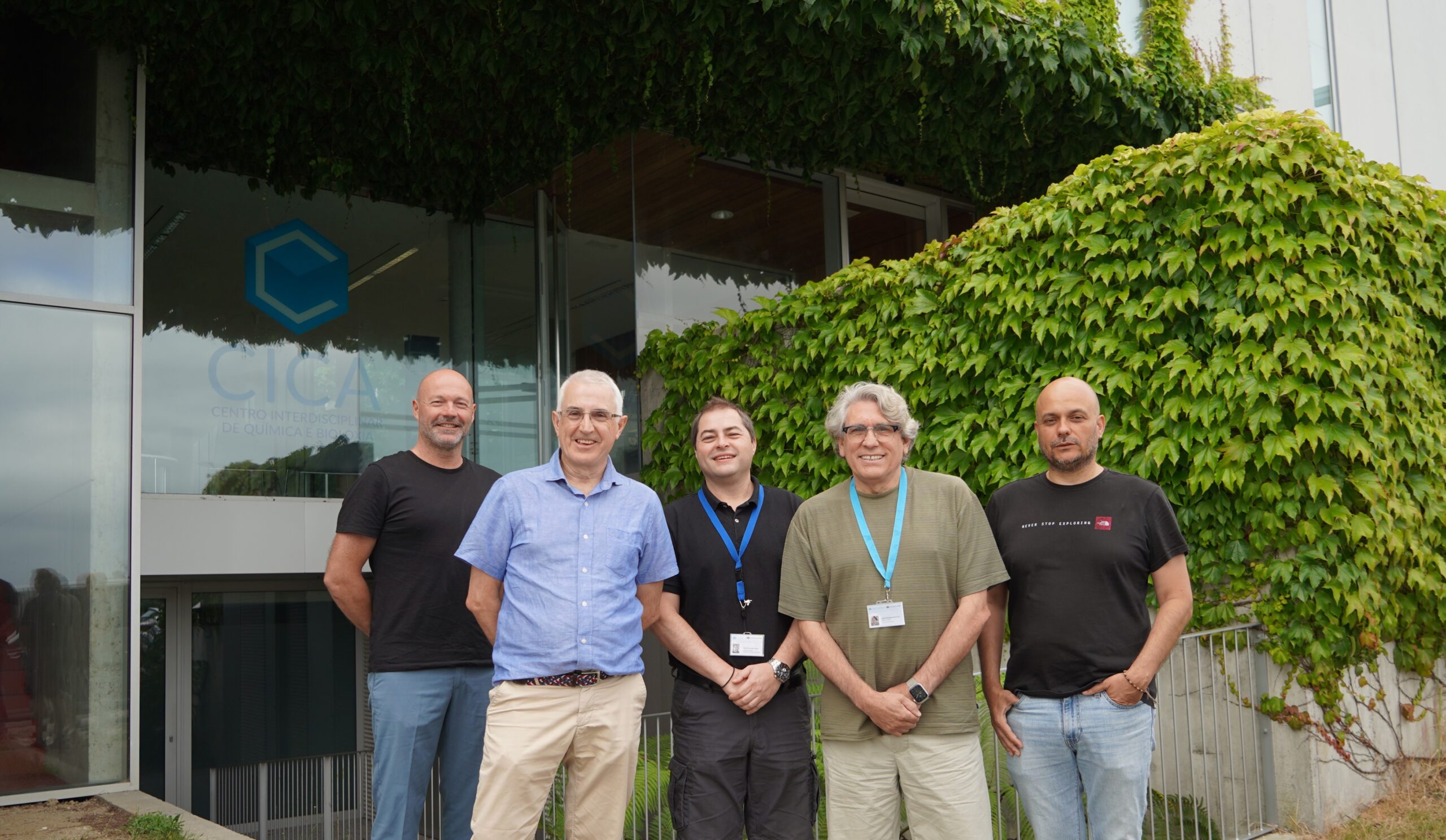
The Interdisciplinary Centre for Chemistry and Biology (CICA) of the Universidade da Coruña (UDC) will coordinate the European project CLIRAQUA (Climate Resilience and Adaptation in Aquaculture), a transnational initiative aimed at strengthening the resilience of Atlantic aquaculture against the effects of climate change. The project brings together 12 entities from Spain, Portugal, France, and Ireland, with a total budget of 1.96 million euros, 75% of which is co-financed by the European Regional Development Fund (ERDF) through the Interreg Atlantic Area program.
More specifically, the purpose of CLIRAQUA—which falls under the strategic objective of promoting climate change adaptation through ecosystem-based solutions and innovative technologies—is twofold. On one hand, it aims to reduce the vulnerability of aquaculture species and environments to phenomena such as rising temperatures, salinity, or declining water quality. On the other hand, it seeks to develop practical tools that allow producers, administrations, and local communities to anticipate and adapt to these challenges.
The expected results of this project, as detailed by the UDC, include the creation of the Atlantic Data Lake, featuring climate and ecological data to generate interactive vulnerability maps; adaptive management protocols for producers and administrations based on scientific evidence; and an early warning system for diseases associated with changes in temperature and salinity. Additionally, the creation of a Transnational Aquaculture Resilience Network is planned to facilitate the adoption of best practices beyond the scope of the project. Furthermore, CLIRAQUA will promote public participation and collaborative governance to integrate climate adaptation into regional and national policies for the sector.
The project will have a duration of 30 months, running from July 2025 to December 2027.
GALICIA AS A BLUE INNOVATION HUB
The coordination of the project by CICA, the UDC highlights, “is an example of the center’s capacity to integrate various scientific disciplines to face complex challenges such as climate change.” In fact, the research team combines profiles in coastal biology, marine bioactive products, evolutionary ecology, climate change, and biomedicine.
Thus, Jaime Rodríguez and Carlos Jiménez (PRONAMAR group), experts in marine bioactive compounds, address the potential of these resources in sustainable aquaculture. Javier Cremades and Rodolfo Barreiro (BIOCOST group) contribute decades of experience in coastal biodiversity, habitat restoration, and marine species. Roberto Bao and Armand Hernández (GRICA) are responsible for climate analysis and the integration of predictive models. Pablo Pita (GIBE), a specialist in evolutionary biology in marine systems, works on the socioeconomic aspects of the adaptation of exploited species to new environmental conditions. Finally, Daniel Torrecilla, Head of Projects, Innovation, and R&D Strategy, a technologist with experience in biomedicine, reinforces the innovation and management side of European projects.
The project, according to the same sources, aligns with Galician and European blue economy strategies, as well as the principles of the European Green Deal, the Territorial Agenda 2030, and the EU Climate Change Adaptation Strategy. It also capitalizes on synergies with other European projects such as ClimeFish, BlueAdapt, or AQUA-LIT, “consolidating a knowledge network that transcends borders.”
A MULTIDISCIPLINARY CONSORTIUM
The CLIRAQUA consortium is composed of universities, research centers, public agencies, and technological industrial clusters from Spain, Portugal, France, and Ireland.
-
From Spain: In addition to the Universidade da Coruña – CICA (coordinator), participants include the University of Las Palmas de Gran Canaria (University Institute of Sustainable Aquaculture and Marine Ecosystems); Asociación Bioga (Life Sciences Technological Business Cluster); the Institute of Marine Research (Spanish National Research Council – CSIC); and the company Seafood Legacy SL.
-
From Portugal: Participation comes from the Interdisciplinary Centre of Marine and Environmental Research (CIIMAR), the Instituto Português do Mar e da Atmosfera (IPMA), and the Universidade dos Açores.
-
From France: Institut National de Recherche en Agriculture, Alimentation et Environnement (INRAE) and the Centre pour l’Aquaculture, la Pêche et l’Environnement de Nouvelle Aquitaine (CAPENA) are involved.
-
From Ireland: The Marine Institute and the University of Galway complete the Irish participation.