
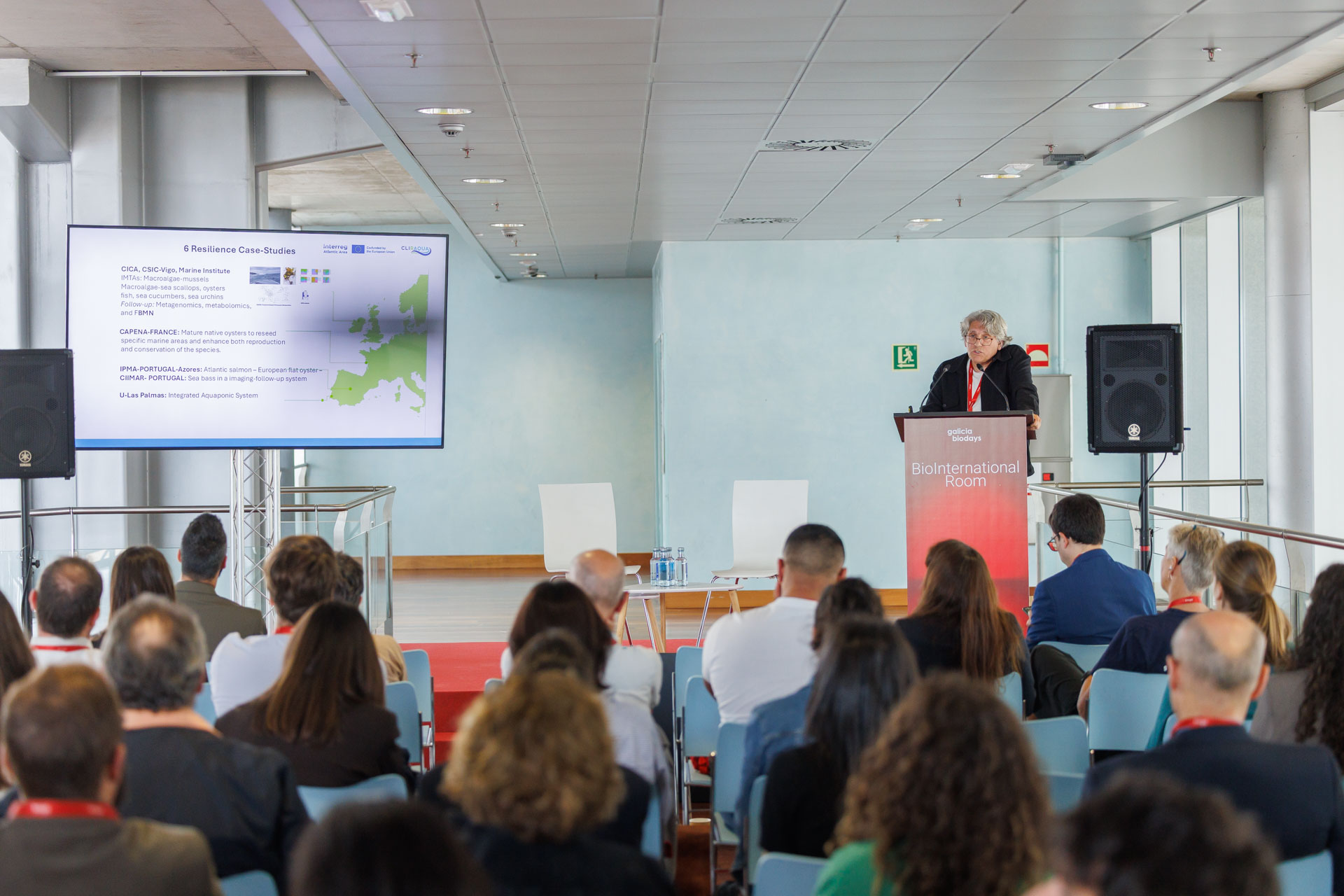
The European project CLIRAQUA (Climate Resilience and Adaptation in Aquaculture) was presented at Bioga’s GaliciaBiodays. The presentation was given by Jaime Rodríguez from the PRONAMAR group, an expert in marine bioactive compounds.
CLIRAQUA is an initiative coordinated by CICA, the Interdisciplinary Centre for Chemistry and Biology at the Universidade da Coruña, which seeks to strengthen the resilience of Atlantic aquaculture to climate change. Specifically, CLIRAQUA will aim to reduce the vulnerability of species and aquaculture environments to rising temperature, salinity changes, and declining water quality.
In addition, the project will develop practical tools for producers, public administrations, and local communities. To that end, CLIRAQUA will create a repository of climatic and ecological data, interactive vulnerability maps, adaptive management protocols, an early-warning system, and a transnational aquaculture resilience network. The project budget amounts to €1.96 million.
A multidisciplinary consortium
The CLIRAQUA consortium is made up of universities, research centres, public agencies, and technology industry associations from Spain, Portugal, France, and Italy. From Spain, besides the Universidade da Coruña – CICA, which coordinates the project, participants include the University of Las Palmas de Gran Canaria – Institute for Sustainable Aquaculture and Marine Ecosystems; the Bioga Association – Business Technology Cluster for Life Sciences; the Institute of Marine Research – State Agency Spanish National Research Council (CSIC); and the company Seafood Legacy SL.
Portugal’s participation comes from the Interdisciplinary Centre of Marine and Environmental Research (CIIMAR), the Portuguese Institute for the Sea and the Atmosphere (IPMA), and the University of the Azores; France is represented by the National Research Institute for Agriculture, Food and Environment (INRAE) and the Centre for Aquaculture, Fisheries and the Environment of Nouvelle-Aquitaine. The Marine Institute and the University of Galway make up the Irish participation.